skip to main |
skip to sidebar
 I visited Berlin recently (amazing) and whilst wandering around the area near the central train station attempting to find the Hamburger Banhof Museum for Contemporary Art (it was oddly difficult for me to locate the entrance), I stumbled across an uncharacteristically sandy area labeled "Sandstation". Entering the space for a small fee of 5 Euro, I found a beachy haven with large umbrellas, beach chairs, beer stands (naturally, this is Germany), and a host of fascinating and incredibly impressive sand sculptures from a collection of international artists.
 The first section was devoted to animal subjects, and included a little area for kids to make their own sand creations. I dug the elephant by Johanna Landscheidt and two-headed dragon from Lena Tempich the most.
 The main portion was the competition itself, with the theme "City of the Future", so many works involved robotic or computer imagery. I really enjoyed every piece- it was consistently astounding to see the level of detail and the scope of the designs (full view on the photos is recommended). There was a good blend of conceptual and literal interpretations of the challenge. I wish I could have seen the artists' building processes, since I'm pretty baffled by how they achieved certain effects. The following is a selection of my favorites (which is the bulk of entries in the competition, really).

 Escape from Virtuality by Ukranian artist Irina Taflevskaya was easily my favorite. It's bold and striking, with a fantastic concept and straightforward, uncluttered execution. Caught my eye instantly, even from beyond the area's surrounding fence.
 Indian artist Sudarsan Pattnaik imagines an idealistic future with City of Peace, showing Buddha visiting Berlin during its peaceful time, with elements of Indian architecture incorporated into the composition.


 Seven artists from different countries worked together on the monumental Berlin in 2222, a sprawling, mountainous piece combining jagged tiers with various figural elements. It was very hard to get a full photo of it due to its size, but here are some detail shots. The artists are: Lisa Buchholz, Johanna Landscheidt, Edwin Spaan, Lena Tempich, Martin Tulinius, Niels Vegter, and Johannes Weckl.

 Shift by Toshihiko Hosaka of Japan is an interesting mix of human features with hard, industrial surfaces, and a little bit of outer space thrown in. I like the overall shape very much (he was inspired by Mt Fuji as well as Berlin's Sony Center ceiling) and really appreciate the detail and texture of the hands and figure.

 Berlin-based artist Ulrich Baentsch paid homage to Rodin with The Thinker. As I approached I thought it was just his own sandy version of the classic sculpture, but seen from the other side it is revealed to be partially composed of "bricks" cracking through the smooth facade.

 Danish artist Maria Eliot Torp brings us One More Beer, a rendering of the "bar of the future". I love the sci-fi elements here as well as the thoughtful design of the space and its characters. It focused more on expression than most of the other pieces.

 Belgian artist Isabelle Decallonne envisions a future headed by women, though still inseparable from the male-dominated past in her large piece Past and Future. I'm not enamored of the execution (the female form looks a little awkward in her positioning, shape, and relation to the buildings below her), but I really like the concept.

 Will We Let Us Raise Our Own Children? from Netherlandish artist Joris Kivits was my other favorite. In his version of the Virgin and Child motif, he replaces Mary with an android covered in a shroud, connected to large pumps and wires. She "breastfeeds" a faceless human child through a tube. It's a very blatant and slightly disturbing image, but exceptionally executed and quite memorable. Its large size definitely helps it make a lasting impact.
This really interesting event continues through August 30, so if you happen to be in the Berlin area any time before then, I highly recommend it! It was a wonderfully singular experience for me.
 I meant to get this up weeks ago but forgot/things came up. The Städtische Galerie in Albstadt (don't think it has an English website, sorry) just held a very interesting exhibition dedicated to Austrian artist and architect Friedrich Stowasser, better known as just Hundertwasser ("hundred waters" in German). His paper works are characterized by childlike compositions and environmental themes, exploding with vibrant color and meticulous patterns. His architecture, reminiscent of Gaudi, defies straight lines for being "godless" and instead swirls and swoops around in waves and circles. I actually always pass his Wohnen unterm Regenturm in Plochingen when I take the train to Stuttgart. Most of the work at the exhibition focused on his prints, though. Let's look!
 I was gleeful seeing his metallic paints and eye-popping colors- it kind of reminded me of Dubuffet. So fun! And I love that his prints emulate Japanese-style prints with his personal stamp and everything. Adorable.


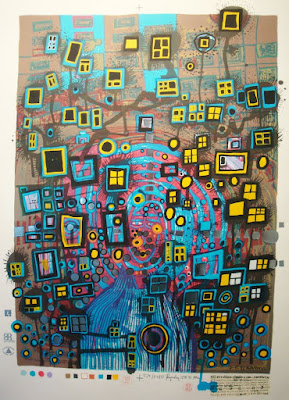 He also designed a poster for the 1972 Olympics.
 He has some wacky building designs.
 At the end there were several models designed by school groups who had visited. It's a really cute idea, I think!
 I'm really glad I went to see this exhibition, as it offered an interesting window into the life of an artist I had previously known nothing about. There was a lot of biographical and personal information, which I appreciated, as well as a video of him working at home and some of the weirdness of his life (like eating soup over his work, mixing in paprika with paint pigment bottles- yeesh). My next goal is to see more of his architecture- hopefully I will make it to Austria some time!
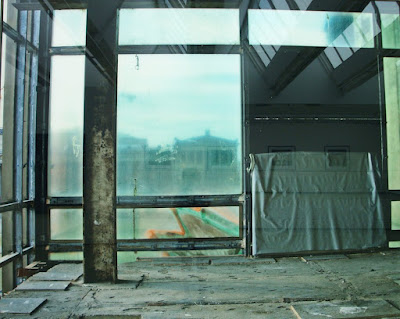
 Tübingen's main art museum, Kunsthalle Tübingen (sorry but the site is almost completely in German), is actually more of a gallery space, in a small but beautiful and well-laid-out building positioned on a sunny hill. Their current exhibition, titled Der Innere Blick ("The Interior View"), brings together several contemporary painters and photographers who focus on the various aspects of interior spaces. It's a simple but fascinating theme, with much room for exploration.The first room shows the photography of Marina Gadoneix (France) and Thomas Florschuetz (Germany). The former's work is bright with neon lights and crisp, stark spaces. Everything is sleek and modern and full of contrasting colors. Unfortunately I couldn't get any good photos of her pieces due to the glass reflection, but she has a portfolio on her website. Florschuetz focuses more on the grittiness of large, open interiors such as many-windowed and derelict warehouse-like spaces. There's a halting sense of abandonment throughout his settings, but overall I wasn't especially engrossed by the photos.

 I found Peruvian photographer David Zink Yi's Roma series incredibly affecting. He takes quiet, neatly laid-out rooms populated by a scarcely-seen elderly woman (his grandmother). Her veined hand or sandaled foot will edge its way into the frame of the photograph, acting as a disembodied limb. He reminds us that a human presence is necessary for all of the lace table cloths, decorative paintings, and cushy couches seen in the main composition. The works carry with them a strong atmosphere of loneliness, as if this woman has nothing but her surroundings to keep her company. They are both serene and slightly disturbing, creating a unique portrait. They reminded me a bit of William Eggleston's more domestic photos.

 One of the reasons I really wanted to visit the Kunsthalle was I'd read that Richard Hamilton's Just What Is It That Makes Today's Homes So Unique, So Appealing? (1956) was part of its collection. Upon learning that it was more of an exhibition space and had no permanent objects of its own, I was pretty sad. But then there it was! All by itself and surprisingly tiny, but there in all its Pop collage glory. I love this piece, and it fits really well into the exhibit's theme, portraying "today's" homes with over-the-top irreverence and familiar trappings of modern living.
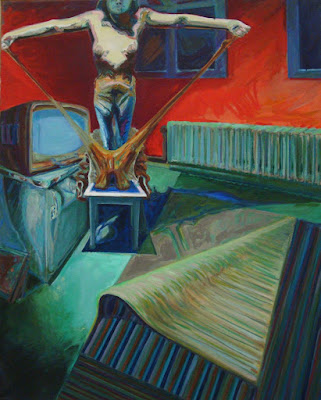
 British artist Ian Hartshorne's paintings are vibrant and dreamlike, utilizing broken angles and slightly garish colors to create a vaguely surreal interior space. He'll take a familiar substance like wood but break it up unevenly and combine it with a red staircase that seems to float and a statuesque android, catching the viewer off guard. His works are interesting, but I didn't particularly like them. Something about his painting style, I think, but I can't quite put my finger on what I didn't like. They just didn't grab me. Sort of emotionless, I guess.

 I did enjoy Czech artist Daniel Pitin's paintings, dimly lit and full of dripping strokes and unfinished edges. He distorts the spaces that he chooses to depict, with unclear walls and crouched figures who somehow seem disconnected from their surroundings. I especially like Lost Architect. It conveys a sense of loss and uncertainty, but without reverting to despair. There's a large collection of his images here.

 Achim Hoops' works are a surprise delight, at first glance appearing dull and monotonous, but upon closer inspection revealing a keen eye for light and serious skills with crayon and colored pencil. The pieces are small ruminations on various empty interiors and exteriors, with dichromatic palettes and detailed line work. They are textured and grainy, focusing as much on the medium and wooden canvas as the composition. Really a treat to see in real life.


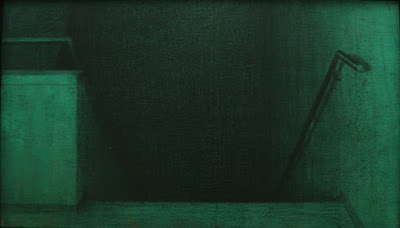 Unfortunately I can't find the video for Swedish artist Sofia Hultén's Familiars (2007), but it is really interesting. It's composed of a selection of short scenes all filmed inside a regular house, in which a figure would set up some sort of strange trick to presumably scare any family member who walked in. A woman lay hidden under a bed and moved it around so it seemed to be levitating. Another hid inside a dresser and hung her arms outside a drawer like a dead body. It's a cool look into the potential terrors of everyday home life. I don't know much about the artist but I'm interested to look into what her other work is like. There some more photos of it here.
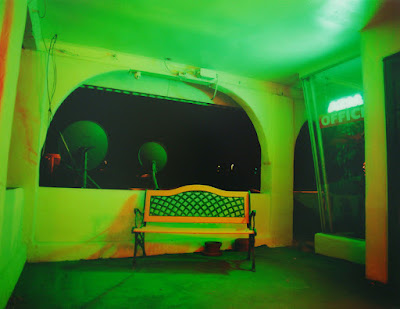
 Absolutely exploding with color and passion are the large-scale photographs of American artist Raissa Venables. She finds interesting architectural patterns and unreal lighting and exploits them to their fullest potential. Her works are fascinating, decidedly off-beat compositions packed with a nagging feeling that something here isn't quite right.


 This is a really wonderful exhibition, with a range of styles from an international collection of artists. The Kunsthalle defies its small space with an impressive display of works, making for an interesting and truly enjoyable visit. This exhibit is up until July 5, if you happen to find yourself in the Tübingen area (though I understand that probably isn't a likely occurance for most of you). Hopefully I'll be able to catch their next exhibition on Israeli artist Tal R before I go back home.
 I went to Munich for a weekend and it was absolutely lovely- lots of Bavarian architecture and clothing, rolling hills and grand streets. Though I didn't have long, I was able to devote a Saturday morning to two of their main museums: Neue Pinakothek, which houses works from the 17th and 18th century, and the Pinakothek der Moderne, for the 1900's to present. I have to say I was much more impressed with the latter.
 Its building is lovely, with a lobby reminiscent of the Guggenheim but without the tiring uphill layout. Their collection covers many areas, from famed Modern and Contemporary painters to furniture design, from jewelry to architecture draftsmanship. Unfortunately I didn't have the time to see it all, and spent most of my visit in the Modern and Contemporary art section, waltzing quickly past the Ikea and Klaus Kinold exhibits after a brief look at the Zoe Leonard photo show (which I enjoyed, but don't have much to say about).
 First off was some superb Expressionism with several works from Kirchner, Schmitt-Rotluff, and the like. And maybe you'll remember: I really dig German Expressionism.


 I've noticed in the few museums I've so far visited in Germany, that there is a definite focus on showcasing German and Austrian artists. It's kind of cool. I'm accustomed to American museums, which usually don't lean toward a specific country representation unless it is significantly part of the museum's mission (ie the Whitney as a center for twentieth century American artists, etc). This way I am able to see a lot of German artists I hadn't heard of before, who perhaps hadn't become as successful outside of their native country, as well as a wider selection from German artists I already knew about. Which all adds up to: Learning!
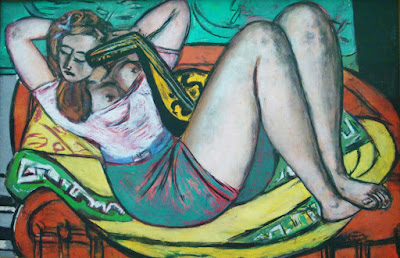
 Max Beckmann had his own gallery, which I adored. Included were several self-portraits, a piece (Woman with Mandolin) I've seen in the Busch-Reisinger Museum at Harvard (though maybe it was just on loan?), and a triptych (in case you haven't seen enough already).

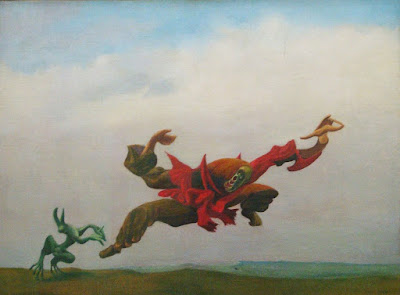
 There was a small collection of Surrealist works. I liked the Max Ernst pieces- he's an artist I know about, and whose importance I understand, yet I have only seen a small portion of his pieces.


 George Baselitz had a small exhibition in one room. Large-scale, textured paintings combining abstract brush strokes with representative figures, all of them vaguely menacing. I will keep an eye out for more of his work.

 One room was filled with Sigmar Polke's series 8 Loop Images, so I was a happy camper. Gorgeous abstract images combining delicate calligraphy-like scribbles and sandy backgrounds. A wonderful exploration of layering and texture. I am constantly impressed with how varied and extensive Polke's talents are. He can never be pigeonholed into one medium, technique, or movement. Awesome.


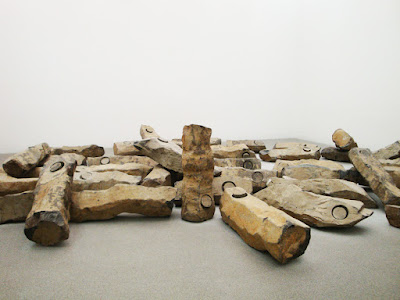
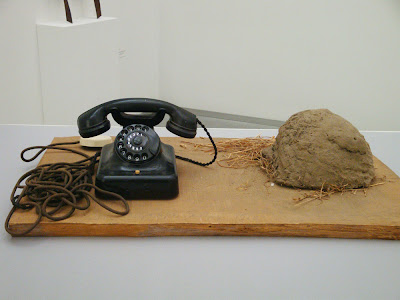
 Lots of Joseph Beuys objects, as well as the chilling room-size installation The End of the 20th Century, composed of large, scattered basalt structures resembling ruins. It's hard to describe without being there, but it had this unearthly calm and quiet that I found very affecting. I really dig Beuys for his weirdness and boundless imagination. I would have loved to see one of his performances. Also check out this cute Warhol portrait. He looks so befuddled.

 Discovered contemporary German artist Norbert Tadeusz in one gallery. Interesting works: mostly ambiguous nudes in dimly-lit rooms, with off-kilter compositions and angles. I loved some, while others didn't move me much. His attention to shadow gives an eerie, compelling mood to his paintings, but sometimes I was thrown off by his color choices.
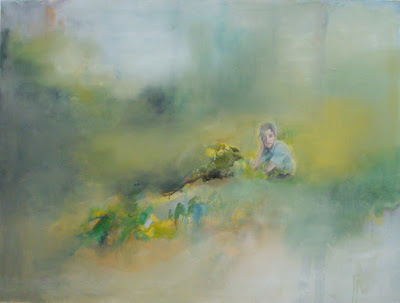
 Small room dedicated to Jochen Klein, another new German artist to me. I really, really enjoyed his paintings. They are small, figural scenes in abstract nature settings. The figures are detailed and emotional, surrounded by incredibly soft, blurred brushstrokes. Everything is so light and subtle, and just really beautiful, but with a slight uncanny air. Unfortunately Klein, who was diagnosed with AIDS, passed away in 1997 at only 30 years of age.


 Light art, yay! No Turrell, though, which is always too bad. Nothing wrong with Flaving, I just like Turrell better. I find his works much more emotional.

 I really enjoyed the Pinakothek der Moderne, and I only saw 1/4 of its contents! It's well-organized, beautifully designed, and features an impressive collection of modern and contemporary artists. Highly recommended to anyone visiting Munich.

 The first section was devoted to animal subjects, and included a little area for kids to make their own sand creations. I dug the elephant by Johanna Landscheidt and two-headed dragon from Lena Tempich the most.

 Seven artists from different countries worked together on the monumental Berlin in 2222, a sprawling, mountainous piece combining jagged tiers with various figural elements. It was very hard to get a full photo of it due to its size, but here are some detail shots. The artists are: Lisa Buchholz, Johanna Landscheidt, Edwin Spaan, Lena Tempich, Martin Tulinius, Niels Vegter, and Johannes Weckl.