skip to main |
skip to sidebar
 Two new exhibitions at the Tufts Art Gallery debuted at the end of January. Exciting!
.jpg) The main one, housed in the Tish Gallery (top floor), is titled A Tapestry of Memories: The Art of Dinh Q Lê, a survey of the Vietnamese-American artist's work. He and his family were forced to leave Vietnam when he was young, subsequently living in Thailand and the US. He has since moved back there, and much of his work examines the relationship between America and Vietnam and their images of one another.
The main one, housed in the Tish Gallery (top floor), is titled A Tapestry of Memories: The Art of Dinh Q Lê, a survey of the Vietnamese-American artist's work. He and his family were forced to leave Vietnam when he was young, subsequently living in Thailand and the US. He has since moved back there, and much of his work examines the relationship between America and Vietnam and their images of one another.
 Much of average Americans' knowledge of Vietnam of course relates to the Vietnam War, and much of that information comes from films and books relating to the event. Lê uses a lot of imagery from Apocalypse Now and Platoon to illustrate this point. In the video installation From Father to Son: A Rite of Passage, two screens positioned next to each other show footage from these films, one highlighting Martin Sheen and the other his son, Charlie Sheen.
 The accompanying photo tapestries involve weaving images of films and the actual war. These tapestries are the main event of the exhibit, popping up in both rooms and incorporating multiple subjects.
 Many focus on the Vietnam War, while others blend Eastern and Western religious iconography.
 These works are really exceptionally pieced together. One must shift his or her eyes in different ways to see each layer. At first it can seem like a semi-abstracted mess but upon closer inspection each section comes together across multiple levels to form a complex and intriguing image. Unfortunately I couldn't get any decent photographs, but I feel it's impossible to see their full effect without being physically there, anyway.
 The exhibit also showcases two embroidered canvases, a very subtle technique with figural subjects. Again, these definitely benefit from being seen in real life.
 The largest piece is a "quilt" compiled from photographs that hangs from the ceiling. It is Lê's attempt to reconstruct the lost history of his own family by meshing together found postcards and photos of anonymous Vietnamese families.
 As much as I enjoyed Lê's work, Christian Tomaszewski: Hunting For Pheasants
 In the sculpture court are hung bold spheric lights.
 The floor-to-ceiling windows are painted with thick piebald stripes, transforming the room when sunshine floods in. It is very pretty. (Images from Quabit's Flickr.)
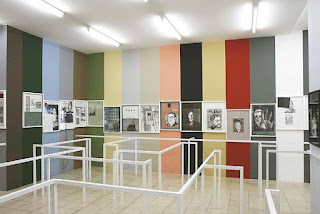 Inside, the space has been transformed into a knee-level maze. The stripes continue all around the walls, serving as backgrounds to his imaginative portraits of people, real and imaginary, who have been assassinated, often with political motivations.
 He incorporates techniques of silkscreening, collage, painting, and drawing to create eye-catching pieces resembling movie posters.
 Neon lights and blocks of text pop up here and there, as well. They're all housed in the same-small-sized white frames but the images vary in measurements. I could lose myself in this room, easily, trying to piece together the stories Tomaszewski is trying to tell as a part of his wacky pop labyrinth.
 The Tufts University Art Gallery is open every day except Monday from 10-5, and until 8 on Thursdays. It's free (but please donate!) and the people who work there are super nice! Both of these exhibits will be open until March 29, 2009.
Further Reading:
Boston Phoenix
Tufts Daily
Despite the fact that I am a fairly gung-ho employee of the Tufts Art Gallery, I'm sure I would have written about its marvelous current exhibit "Empire and Its Discontents" even if I didn't work there. Inspired by Edward Said's 1978 book Orientalism, it features contemporary artists from countries that have been affected by colonialism, and whose work examines the mixture of Eastern and Western cultures. There are ten artists in all, with a related exhibition downstairs, "Contrapuntal Lines: Rania Matar and Buthina Abu Milhem" that has been similarly inspired. Most of the pieces use traditional mediums like painting, ink, photography, video, and sculpture, with one site-specific installation and one cardboard construction. It runs until November 23, and admission is free! If you're in the Boston/Cambridge/Somerville/Medford area, definitely check it out.
 Kamrooz Aram has several paintings in the show, including this large-scale abstract narrative piece. You can really lose yourself in it.
 I really dig Andisheh Avini's work. He has patterned sculptures that highlight the layering of Persian and American cultures over and under one another.
 He also does really interesting collage-paintings that incorporate bleach to achieve a ghostly effect.
 Pakistani artist Saira Wasim makes really complex miniature paintings in the Mughal style, with highly satirical political subjects. Her skill and humor shine equally.
 One of my favorite works in the show is Egyptian artist Laura Baladi's photographic series The Surface of Time. There are about eight pairs of photos whose compositions depict the ruin and decay she has seen in Egypt since the rise of its current president, Hosni Mubarak, 25 years ago. I love the high saturation and sense of abandonment she captures in these empty rooms and vacated exteriors. I couldn't really find any other images online, unfortunately. You'll just have to see for yourself!
 My other favorite piece is a video by French-Algerian artist Zoulikha Bouabdellah titled Black & White #2. In close-up, stop-motion-ish slowly fading shots, it depicts a woman in high-contrast black and white performing Muslim prayer motions with her hands. Google maps shift in the background with locations like Baghdad pin-pointed. In the background is heard "The Star Spangled Banner" in an accented voice. It can be oddly mesmerizing.
 Kenneth Tin-Kin Hung has the most visually stimulating piece with his audacious Presidential Erection, a cardboard cut-out focusing on Democratic and Republican presidential candidates and their supporters, with images entirely appropriated from the internet. It's really complex and bawdy, with tons of layers and little hidden images. I find myself staring at it unconsciously when I'm working, trying to identify all of the people and symbols. I like its double-sided aspect too. Apparently there's a video component (not in the exhibition, but it's on his website). He also has a pretty funny video/online game, Gas Zappers, on the New Media Wall.
Other artists include: Seher Shah, with stark black and white photo reconstructions focusing on religious iconography; the graphic novelist Marjane Satrapi, with some enlarged pages from her comic Persepolis; Mark Shetabi, whose installation A Persian Garden recalls his childhood memories of Iran in the late 1970's; and Farhad Moshiri and Shirin Aliabadi, who take common food and cleaning items and re-brand them with thought-provoking messages.
Further Reading:
Tufts Daily
Boston Phoenix

 Two new exhibitions at the Tufts Art Gallery debuted at the end of January. Exciting!
.jpg) The main one, housed in the Tish Gallery (top floor), is titled A Tapestry of Memories: The Art of Dinh Q Lê, a survey of the Vietnamese-American artist's work. He and his family were forced to leave Vietnam when he was young, subsequently living in Thailand and the US. He has since moved back there, and much of his work examines the relationship between America and Vietnam and their images of one another.
The main one, housed in the Tish Gallery (top floor), is titled A Tapestry of Memories: The Art of Dinh Q Lê, a survey of the Vietnamese-American artist's work. He and his family were forced to leave Vietnam when he was young, subsequently living in Thailand and the US. He has since moved back there, and much of his work examines the relationship between America and Vietnam and their images of one another. Much of average Americans' knowledge of Vietnam of course relates to the Vietnam War, and much of that information comes from films and books relating to the event. Lê uses a lot of imagery from Apocalypse Now and Platoon to illustrate this point. In the video installation From Father to Son: A Rite of Passage, two screens positioned next to each other show footage from these films, one highlighting Martin Sheen and the other his son, Charlie Sheen.
 The accompanying photo tapestries involve weaving images of films and the actual war. These tapestries are the main event of the exhibit, popping up in both rooms and incorporating multiple subjects.
 Many focus on the Vietnam War, while others blend Eastern and Western religious iconography.
 These works are really exceptionally pieced together. One must shift his or her eyes in different ways to see each layer. At first it can seem like a semi-abstracted mess but upon closer inspection each section comes together across multiple levels to form a complex and intriguing image. Unfortunately I couldn't get any decent photographs, but I feel it's impossible to see their full effect without being physically there, anyway.
 The exhibit also showcases two embroidered canvases, a very subtle technique with figural subjects. Again, these definitely benefit from being seen in real life.
 The largest piece is a "quilt" compiled from photographs that hangs from the ceiling. It is Lê's attempt to reconstruct the lost history of his own family by meshing together found postcards and photos of anonymous Vietnamese families.
 As much as I enjoyed Lê's work, Christian Tomaszewski: Hunting For Pheasants
 In the sculpture court are hung bold spheric lights.
  The floor-to-ceiling windows are painted with thick piebald stripes, transforming the room when sunshine floods in. It is very pretty. (Images from Quabit's Flickr.)
 Inside, the space has been transformed into a knee-level maze. The stripes continue all around the walls, serving as backgrounds to his imaginative portraits of people, real and imaginary, who have been assassinated, often with political motivations.
 He incorporates techniques of silkscreening, collage, painting, and drawing to create eye-catching pieces resembling movie posters.
 Neon lights and blocks of text pop up here and there, as well. They're all housed in the same-small-sized white frames but the images vary in measurements. I could lose myself in this room, easily, trying to piece together the stories Tomaszewski is trying to tell as a part of his wacky pop labyrinth.
 The Tufts University Art Gallery is open every day except Monday from 10-5, and until 8 on Thursdays. It's free (but please donate!) and the people who work there are super nice! Both of these exhibits will be open until March 29, 2009.